
A featured contribution from Leadership Perspectives: a curated forum reserved for leaders nominated by our subscribers and vetted by the Construction Tech Review Advisory Board.

Datwyler Group
Machine Connectivity: Where Edge Computing Fits?

Manufacturing companies are more and more relying on machines. It all started with the first Industrial Revolution and then it evolved through usage electricity, the adoption of automation until the current 4th revolution dogma based on interconnectivity and intelligence: the cyber physical systems.
Machines are and remain the highest investment for manufacturing companies, be they transforming or assembling, for continuous or discrete process, mass production or one-piece flow. And the calling imperative is always: increase productivity!
From an entrepreneurial perspective, there is nothing worse than underutilized machines: it is just like throwing the money in out-of-fashion clothes, or buying a vacation house in the wrong location.
The point is that we do not know enough about our machines: we did not build them, in most of the cases, and after years of operating, we’ve learnt to set them up, tune them and let them run, until the next break down. And sometimes breakdowns are real nightmares, where after days of downtime we discover that that 2 € part that cause the break was simply not replaced during the last maintenance run, as everybody was claiming: that will never break!!!
There are then 3 main steps that every company should follow to leverage machine data and transform them in to value:
1. Connect: Connectivity is the condition sine qua non to enable any data analysis approach.
There are several ways to connect machines, plenty of suppliers that are offering universal and infallible connection platforms and each of them comes with a full set of functions that will fulfil any possible need.
But usually there is a multitude of different machines, with different technology of different ages and so it is always a big issue to identify the right platform to achieve this.
2. Visualize: Visualization of key machine data is a straightforward way to generate value: we can learn more about what has happened and is happening during the production process, enabling a kind of Gemba also for the machines.
Be they diagrams, alarms, colourful charts or simply data on a spread sheet, now we can enable the next: understand.
And this is where human intelligence makes the difference: if we understand a problem we can solve it and think how to prevent it to happen again.
3. Improve: Once we are able to see and understand what is happening inside the machine then we can eventually trigger the improvement. Now Operators and production managers can easily see how the machine is operating and act to improve its behaviour, both on the productivity and quality side. Recognizing why a breakdown happened or how to achieve constant quality is not just in the head of the experienced employees but can be learnt and replicated.
Now we can access eventually the exciting analytical methods based on Artificial Intelligence, Machine Learning and Deep Learning to find improvements also in what we cannot actually see.
As of my experience, such advanced method can really bring value when all the key people in the shop floor are fully used to visualize and use data to improve. Expecting magic from an AI solution can be very disappointing.
The technologies available to achieve these 3 steps are a lot, but after a deep evaluation, we have elaborated a underpinning concept: the connectivity platform should deal with all existing standards, but also able to easily host custom connectors for the oldest devices. It should also allow to simply visualize the data, possibly using opensource tools (i.e. NodeRed, PostGreSQL or Grafana) and should be able to host fast and effective algorithm that may stop a machine operation to prevent to produce i.e. bad parts.
Under these perspectives, Industrial Edge fits perfectly.
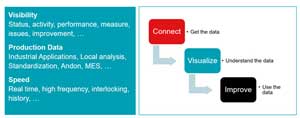
The concept of bringing computing power close to operations, without impacting the busy and critical automation, brings the expected results.
Connectivity can be easily managed for standard protocols (S7, OPC-UA, MQTT) but with a container approach a custom connector can be developed and made available in the shared library.
Machines remain the highest investment for manufacturing companies, transforming or assembling, for continuous or discrete processes, mass production or one-piece-flow. And the calling imperative is always to increase productivity
This creates a flat “surface” that enables also simple connectivity with MES and upper level systems, getting rid of the need to rebuild a connector every time a system requires machine data.
In such environment data can be temporarily stored with high efficiency, aggregated and elaborated for local purposes, typically to feed and Andon or for department trend analysis. The same data can also be easily made available for the Data Lake, cloud based, where all the machines can transfer meaningful, rationalized and compact data for most advanced analytics, to compare how a device is performing, in respect to machine of the same family in a different site.
Local computing power is also one of the main prerequires to have fast intelligent algorithms to run and interact with the machine: adaptive production becomes more achievable, when thousands of machine parameter can be quickly analysed and evaluated, triggering settings correction and reaching the target of constant quality and higher productivity.
The Edge concept is the missing block in the automation chain: be it a Scada or a dedicated Industrial PC, it opens the power of Information Technology to the operational world, bringing the same advantages that we massively use in our laptops or mobile phones in the production environment.

